

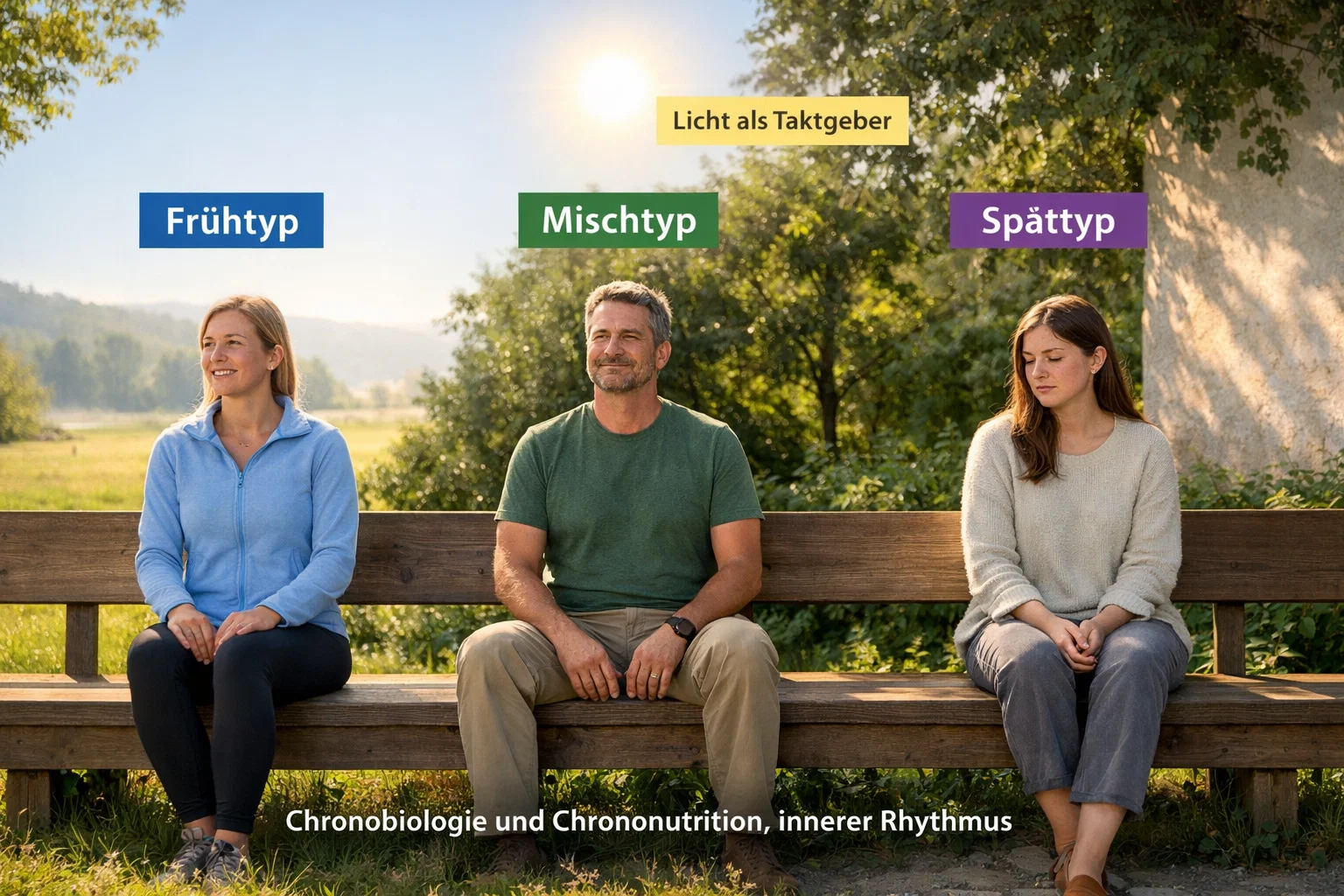
Every human being carries an inner tempo from birth, a rhythm that orchestrates all central processes of life: sleep, digestion, hormone production, metabolism, energy distribution, regeneration, and learning processes follow these rhythms. From adolescence onward, these so called chronotypes, which are genetically anchored, stabilize to a large extent, yet they remain variable across the lifespan. Teenagers are naturally late, in young adulthood they tend to align more closely with their genetic chronotype, and with older age many people shift again toward earlier sleep and wake times. Strong, regular exposure to daylight can shift the rhythm earlier, while irregular sleep times, lack of light, or persistent stress can delay it and push the internal clock out of balance.
I myself am a genetically confirmed extreme late chronotype, with a natural sleep window of roughly 3:45 a.m. to 11:45 a.m. For many years I did not know this rhythm. When I met my husband about twelve years ago, I finally understood why I had experienced a burnout fifteen years earlier. My life as a mostly single mother with a full time job, daily stress, and high demands forced me to get up against my internal clock, usually between 6:30 and 7:00 a.m. Those times cut directly into the phase in which the psyche and the brain regenerate most strongly, memories are consolidated, and learning processes take place. My burnout was purely psychological: in the first months of medical leave I slept up to 16 hours a day, later still 14 hours. Only through a radical adjustment to my internal clock could my body and nervous system stabilize.
Paragraph
Chronotypes, individual, stable, and yet flexible
Chronotypes can be assessed in two ways. The IFADO questionnaire in Dortmund is a well established tool that offers initial orientation based on sleep and activity patterns (https://www.ifado.de/de/chronotyp). However, a questionnaire is subjective and can be influenced by habits, stress, or life circumstances. More precise is the BodyClock hair root test (bodyclock.info), which analyzes genetic markers in order to determine the internal rhythm more objectively. When you know your chronotype, you understand more clearly why certain times for sleep, meals, and performance can be particularly favorable or unfavorable.
Chronotypes are largely genetically determined, and yet they remain flexible within a certain range: age, consistent exposure to daylight, and long term lifestyle changes can shift the sleep wake pattern. This variability helps explain why some people tend to go to bed and wake earlier with increasing age, while adolescents are naturally late. It also explains why extreme late chronotypes or early types can experience particular strain in certain life phases when societal demands and personal biology do not match.

Chrononutrition, eating in harmony with the internal clock
Chrononutrition means aligning nutrition with your individual internal rhythm in order to support digestion, metabolism, the microbiome, and hormonal balance as effectively as possible. A late chronotype like me often does not eat breakfast in the morning at all, but has a strong digestive and metabolic window in the evening. That is why my daily routine is structured so that my “midday breakfast”, fruit and homemade banana bread made from chickpeas, or lentil bread with a spread, is easy to digest, while my main meal around 8 to 9 p.m. consists of protein sources and plenty of vegetables. With this time aligned way of eating, combined with a vegan diet that is as gluten free and sugar free as possible, my blood sugar, energy level, and recovery remain stable.
Chrononutrition also takes circadian hormone cycles into account: cortisol is high in the morning and supports alertness and performance, while insulin sensitivity, digestive enzymes, and blood pressure fluctuate throughout the day. When you eat at times when the body can utilize food best, you reduce the burden on metabolism and the microbiome, lower inflammation, and improve sleep quality and recovery. Studies suggest that meals eaten too late or too early can worsen blood sugar control and increase the risk of chronic disease.
Especially with a vegan or vegetarian diet, it can be worth paying conscious attention to nutrient diversity in order to support the body optimally in all phases. The U.S. Dietary Guidelines (USDA Guidelines 2025–2030) note that plant based diets may require greater awareness for certain micronutrients, including vitamins such as B12 and D, or minerals such as iron, calcium, and zinc. With thoughtful food choices, combining different protein sources, and targeted supplementation when needed, it is entirely possible to cover all essential nutrients while also benefiting from a whole food, plant forward diet for metabolism, the microbiome, and the immune system.
Hormones and circadian rhythms
The internal clock regulates many hormones: cortisol, which helps you wake up in the morning; melatonin, which initiates sleep; insulin and glucagon, which regulate blood sugar; growth hormone, which supports tissue repair and the immune system at night; and ghrelin and leptin, which modulate hunger and satiety signals. When sleep and eating times are consistently shifted, this can lead to chronic misregulation of hormones: blood sugar rises, stress hormones remain elevated, and regeneration is impaired. Chrononutrition helps ensure that nutrient intake happens at times when the enzymes, absorption, and processing of macro and micronutrients are most optimal.
The microbiome throughout the day
Our microbiome also follows a rhythm. Certain bacterial groups preferentially grow at specific times of day, produce metabolites such as short chain fatty acids, or influence immune modulation and inflammatory readiness. Respecting these rhythms, through meals that support digestion and gut motility, promotes microbiome stability and, with it, the immune system. Irregular meals, eating at night, or industrially processed foods disrupt this rhythmic dynamic, which can in turn create a foundation for autoimmune reactions, inflammation, and metabolic problems.

Practical examples from companies and clinical settings
That chronobiology is not merely theoretical but can become effective in everyday life is shown by several practical projects in which individual chronotypes were systematically taken into account.
SPÄH Chrono Study
Within the SPÄH Chrono Study, employees were chronotyped once at the beginning and underwent medical and sleep related assessments. After a defined project phase, a follow up assessment was conducted to capture changes in sleep, daytime well being, and performance capacity. The aim was not to restructure work hours or diet, but first to build awareness of one’s own biological rhythm and make the effects of chronobiological education visible. The results showed, among other things, a longer average sleep duration, a reduced morning performance dip, and improvements in concentration and subjective well being. The project was also covered by media, including “Terra X”, and made clear that simply understanding one’s internal clock can already have tangible effects on health and performance.
Wartenberg Clinic, COPEP® and ChronoClinic
At Wartenberg Clinic, chronobiology was systematically integrated into staff scheduling within the COPEP® project (Chronotype Optimized Personnel Deployment Planning). Since the successful completion of the project, employees have had the option to volunteer for chronotyping in order to better understand their individual internal clock and, as far as clinical routines allow, work in a way that better fits their chronotype. Chronotype determination in the project, and still today, has been carried out using RNA based analyses, with all chronotypes, from very early to very late, included.
On this basis, duty schedules were adjusted as far as possible within the existing structural conditions, with the goal of realistically bringing biological time and social time closer together, not achieving perfect alignment.
In parallel, employees received training to increase sensitivity to chronobiological relationships and were individually advised. The evaluation showed clear improvements, among other things, in sleep quality, daytime sleepiness, headaches, general well being, and motivation. At the same time, illness burden and subjective exhaustion decreased. The project illustrates that chronotype oriented planning can be implemented even in complex structures such as shift work and can create sustainable effects for both employees and organizations.
These practical examples show that chronobiology is not an idealized concept, but a realistic way to support health, performance capacity, and satisfaction when individual biological differences are taken seriously.
The results and methodological details of this project are documented in a white paper that can be accessed via the SleepMaster Academy.The materials provided there explore the underlying chronobiological concepts in greater depth and their practical implementation in everyday working life.
Chronobiology & autoimmune diseases
For people with autoimmune diseases, rhythm and timing are particularly relevant. Persistent deviations from the internal clock due to irregular meal times, shift work, or sleep deprivation increase stress axis strain, inflammatory readiness, and metabolic stress. Chrononutrition can have a regulating effect here by aligning nutrient intake, digestion, and insulin response, where possible, optimally with the internal clock. Studies show that omega 3 fatty acids, fibre rich plant based foods, and micronutrients are particularly effective when they are consumed at times when the body can process them efficiently.
Michael Wieden & the practice of chronobiology
In Germany, the implementation of chronobiology in business, clinical practice, and everyday life is largely taught by Michael Wieden. With the SleepMaster Academy and the first ZFU certified ChronoCoach training programme, he has brought scientific, evidence based practice into the working world. He has supported the projects mentioned above and has successfully implemented chronotype oriented strategies in large companies. His work shows that individual adjustment of sleep, meal times, and activity windows is practically feasible and measurably effective.
Practical tips for non experts
Anyone who respects their internal clock can significantly improve health and performance. It begins with self observation: record sleep and wake times, energy levels, meal times, and mood for at least two weeks. The results can then be validated with the IFADO or BodyClock tests. After that, meal times, work phases, breaks, and movement can be scheduled so that they match your own biological peaks and lows.
For example, a late chronotype benefits from shifting breakfast to a later time, placing meals with a higher proportion of protein and vegetables in the evening hours, and planning the main work phase during the natural high energy time. Early chronotypes, on the other hand, should eat breakfast early, schedule the most important tasks in the morning hours, and prefer lighter meals in the evening.
Self efficacy through rhythm
Chronobiology and chrononutrition are not rigid rules, but orientation tools that help to respect the internal clock, promote recovery, reduce strain on metabolism and the microbiome, and increase psychological stability. Anyone who knows their chronotype, aligns meals and sleep with it, and implements the principles step by step can increase health, performance, and wellbeing in the long term. My own path shows that understanding your internal clock can be life changing, especially during phases of high strain and chronic stress.
Sources:
On meal timing and metabolism:
“Studies show that the timing pattern of calorie intake relative to the internal clock is associated with insulin sensitivity and glucose homeostasis. A later calorie midpoint was associated with lower insulin sensitivity and higher fasting insulin levels, even after controlling for diet and sleep duration.” https://pubmed.ncbi.nlm.nih.gov/40305967/
On metabolic rhythms:
“Chrononutrition research shows that meal timing influences molecular and peripheral circadian clocks. Meal timing can synchronize tissue rhythms and thereby modulate metabolic functions such as glucose and lipid metabolism.” https://pubmed.ncbi.nlm.nih.gov/33222161/
On late meals and metabolic strain:
„A clinical study found that a later dinner led to higher glucose and insulin levels overnight and the next morning compared with an earlier dinner, indicating that the timing of food intake is metabolically relevant.“ https://academic.oup.com/jcem/article/106/2/e1050/5952711?utm_source=chatgpt.com
On chrononutrition and diabetes:
„In studies on diabetes management, chronobiology oriented dietary patterns show that evening chronotypes have poorer postprandial glucose values when eating later, underscoring the importance of aligning meal timing.“ https://pubmed.ncbi.nlm.nih.gov/32075959/
On general metabolic health effects:
„Reviews in chrononutrition research support the idea that eating during the active phase of the day is linked to better metabolic outcomes and that late eating may be associated with an increased risk of metabolic dysregulation.“ https://pubmed.ncbi.nlm.nih.gov/40647240/